
Somewhere in a drawer, or more likely in an inbox folder you have not opened in years, there is a statement for a 401(k) from a job you left a while ago. Maybe two of them. Maybe more. Career changes, layoffs, and retirement itself all leave these accounts behind, and it is remarkably common for people to arrive at retirement with a small collection of orphaned employer plans.
Here is the thing most people do not realize: what you do with an old 401(k) is not just paperwork. It is a decision that can affect your taxes, your investment options, your creditor protections, and your larger retirement income plan. And one version of the decision, done carelessly, can create a tax bill you did not need to have.
Let’s walk through the four main options and the traps worth knowing about.
Option 1: Leave it where it is
Doing nothing is a legitimate option, and sometimes a reasonable one. Many employer plans allow former employees to keep their money in the plan.
Potential upsides: some employer plans offer institutional pricing on investments, and workplace plans generally carry strong federal creditor protections. Some plans also allow penalty-free withdrawals in certain situations for those who separate from service at a qualifying age, which can matter for people retiring in their late fifties.
Potential downsides: you are limited to that plan’s investment menu, you may receive less service and attention as a former employee, and every additional account is one more thing to track. Retirees with three or four old plans scattered across former employers often find that the accounts are not coordinated with each other at all, and no one is watching the whole picture.
Option 2: Move it into a new employer’s plan
If you are changing jobs rather than retiring, many new employer plans accept transfers from old ones. This consolidates accounts, keeps everything under workplace-plan protections, and may preserve certain options, such as the ability to delay required minimum distributions from that plan if you keep working past the age when they normally begin.
The tradeoff is that you are trading one plan’s investment menu and rules for another’s. Whether that is an upgrade depends entirely on the specifics of both plans.
Option 3: Roll it over to an IRA
Rolling an old 401(k) into an IRA is a common path, and for good reasons in some situations: a wider range of investment choices, consolidation of multiple old plans into one account, and the ability to coordinate the account within a broader income and withdrawal strategy.
But it is important to say this plainly: rolling to an IRA is not automatically the right answer, and anyone who tells you it always is has skipped the analysis. IRAs and employer plans differ in their protections, their costs, their withdrawal rules at certain ages, and their planning implications.
Regulators expect rollover recommendations to be documented and justified by a person’s actual circumstances, and that is a standard worth holding any advisor to, including us.
If a rollover is right for you, one mechanical detail matters enormously, which brings us to the trap section below.
Option 4: Cash it out
You can simply take the money. For most people, most of the time, this is the option with the highest cost. A cash-out of a pre-tax 401(k) is generally taxable income in the year you take it, and if you are under the eligible age, an additional early withdrawal penalty may apply on top. A career’s worth of tax-deferred growth ends the moment the check is cashed.
There are genuine hardship situations where people need the money, and that is a human reality, not a moral failing. But cashing out as a matter of convenience, because it seems simpler than the alternatives, is the mistake this article most hopes to help you avoid.
The traps: where good intentions go wrong
Direct vs. indirect rollovers
This distinction matters more than almost anything else on this page. In a direct rollover, the money moves from your old plan straight to the new account without ever touching your hands. In an indirect rollover, the plan sends the check to you, and you must deposit it into the new account within 60 days. Miss it, and the entire amount can be treated as a taxable distribution. Indirect rollovers also typically involve mandatory tax withholding, which creates its own complications. When in doubt, direct is the cleaner road.
Appreciated employer stock
If your old 401(k) holds shares of your former employer’s stock that have grown substantially, special tax treatment may be available that is lost forever if the shares are rolled into an IRA along with everything else. This is a niche situation, but for the people it applies to, it is worth a careful conversation before any paperwork is signed.
After-tax contributions
Some plans contain after-tax money alongside pre-tax money. These dollars have their own rules and their own opportunities, and lumping everything together without checking can forfeit options.
Outstanding plan loans
If you have a loan against your 401(k) when you leave, understand the repayment rules before you move the account, or the loan balance may be treated as a distribution.
A tale of two rollovers
Consider a hypothetical retiree, Susan, leaving her employer at 62 with a 401(k) built over twenty years.
In one version, Susan requests a check, planning to deposit it into an IRA when she gets around to it. Life intervenes, the deadline passes, and a large portion of her retirement savings becomes taxable income in a single year.
In another version, Susan first sits down with a planner and looks at the whole picture: her other accounts, her income needs, her plan’s specific features, and her tax situation. The decision that comes out of that conversation, whatever it is, is executed as a direct transfer with no check ever passing through her hands. This is a simplified, hypothetical illustration for educational purposes, not a recommendation, and real outcomes depend on individual circumstances.
Same account. Very different experience. The difference was not luck. It was sequence: analysis first, paperwork second.
The real question is bigger than the account
An old 401(k) decision is really a question about your whole retirement picture: how this account fits with your other savings, your income timeline, your tax strategy, and your plans for the years ahead. That is why the honest answer to “what should I do with my old 401(k)?” is almost never a one-word answer.
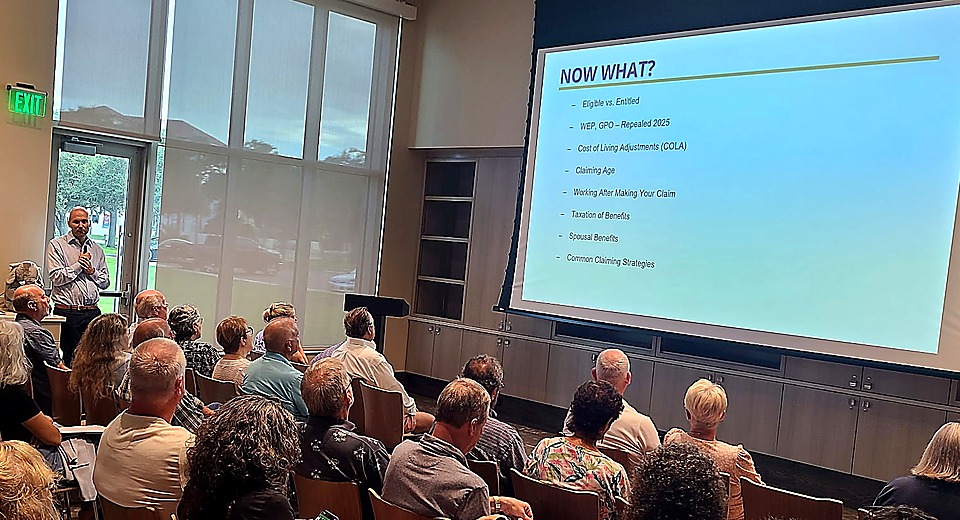
If you have one or more old employer accounts and are not sure how they fit into your plan, we would be glad to help you look at the full picture. We offer a complimentary review of your current accounts, and our monthly educational workshops in New Smyrna Beach and Port Orange cover the income and tax topics that surround decisions like this one. See dates and register at nsbretirement.com/retirement-workshops-new-smyrna-beach-fl, or call New Smyrna Beach Retirement Solutions at 386-402-4626.
Disclosure: This article is for general informational and educational purposes only. Investment advisory services are offered by Signal Advisors Wealth, LLC (“Signal Wealth”), a Registered Investment Adviser with the U.S. Securities & Exchange Commission. Registration with the SEC does not imply a certain level of skill or training. Insurance products and services are offered through New Smyrna Beach Retirement Solutions. Signal Wealth does not offer insurance products. New Smyrna Beach Retirement Solutions is not affiliated with Signal Wealth. Additionally, when New Smyrna Beach Retirement Solutions and/or its agents are recommending and/or selling insurance products they are not acting on behalf of Signal Wealth or in a fiduciary capacity, and instead are governed by the applicable insurance rules and regulations. For more information about Signal Wealth, or to receive a copy of our Form ADV or Form CRS, please visit go.signaladvisors.com/signalwealth. New Smyrna Beach Retirement Solutions is not affiliated with or endorsed by the U.S. Government or any governmental agency. New Smyrna Beach Retirement Solutions and its agents do not provide tax, legal or social security advice. Clients are advised to consult their tax advisor or attorney regarding tax and legal advice and to contact the Social Security Administration at their local office or online at www.ssa.gov. Investing involves risk, including the potential loss of principal. No investment strategy can guarantee a profit or protect against loss. Past performance is not indicative of future results. The information provided herein is for informational purposes only. None of the information contained herein shall constitute an offer to sell or solicit any offer to buy any security, investment advisory or insurance product. Investment advisory services are provided in accordance with a fiduciary duty of care and loyalty that includes putting client interests first and disclosing conflicts. Insurance services have a best interest standard which requires recommendations to be in the client’s best interest. Advisors may receive commissions and other compensation for the sale of insurance and annuity products. Annuity guarantees are backed by the financial strength and claims-paying ability of the issuing insurance company.