
Maybe this sounds familiar. You have been with the same financial firm for fifteen or twenty years. Somewhere along the way, the advisor you started with retired, or was promoted, or your account was moved to a different team. The person who calls once a year now is pleasant enough, but they have never met you, the conversation is mostly about the portfolio, and when you asked a question last spring about Social Security timing, the answer was vague.
Meanwhile, your life has changed completely. You are not saving for retirement anymore. You are in it, or nearly so, and the questions keeping you up at night are not about fund selection. They are about income, taxes, healthcare, and what happens to your spouse if something happens to you.
Here is the honest, uncomfortable question this article is about: is the advisory relationship you have still built for the phase of life you are in?
Saving money and spending money are different jobs
During the accumulation years, an advisor’s job is comparatively contained: help you invest sensibly, keep you contributing, keep you from panicking in downturns. Portfolio oversight is most of the work, and many firms do it competently.
Retirement changes the job description. The distribution years involve a wider set of coordinated decisions: how to turn accounts into monthly income, what order to draw accounts in and what that does to taxes, when each spouse should claim Social Security, how Medicare timing and premiums fit in, how the plan protects a surviving spouse, and how estate documents and beneficiaries connect to all of it.
Portfolio oversight is still part of that picture. It is just no longer most of it. An advisor can be genuinely good at managing investments and still not be doing retirement planning, and many retirees have never been shown the difference.
Signs the fit may have drifted
None of these signs means you must switch advisors. Each one is simply worth noticing:
You’ve been handed off, more than once. If your account has passed through several advisors or teams and no one currently serving you knows your family, your goals, or your history, you may have a portfolio manager of record, not a planning relationship.
Every conversation is about performance. If annual reviews cover returns and allocations but never touch withdrawal strategy, taxes, Social Security, healthcare, or your spouse’s situation, the relationship may be accumulation-shaped in a distribution-shaped life.
Your questions get deflected. When you ask about claiming timing, Roth conversions, or income sequencing and hear “that’s really a tax question” or a vague generality, take note. Coordination across those topics is precisely what the retirement phase requires.
There is no written income plan. If you cannot point to a document that shows how your retirement paycheck works, which accounts fund which years, and what happens to your spouse’s income later, then whatever you have, it is likely not a retirement income plan.
The relationship is far away, in every sense. Distance is not disqualifying by itself. But for many retirees, especially transplants whose advisor is several states behind them, the distribution years are when sitting across a table from someone who knows your community starts to matter.
Why local can matter more now
For Florida transplants in particular, the advisor question deserves a fresh look after the move. A planner up north may be excellent and still be planning around a life you no longer live: a different state’s tax picture, a different healthcare landscape, estate documents drafted under different laws.
Retirement’s biggest decisions also tend to be conversations, not transactions. Households often find those conversations go better with someone local: a planner who can meet face to face, who knows the area’s professionals when an attorney or CPA needs to join the discussion, and who is part of the same community you are.
Questions to ask your current advisor
The fairest way to evaluate fit is to ask directly. Bring these to your next review:
- Can you walk me through my written retirement income plan, in a document I can hold?
- Which accounts will I draw from first in retirement, and what is the reasoning?
- How does my withdrawal strategy affect my taxes over the next ten years?
- How did we, or how will we, evaluate my Social Security claiming decision?
- What does my spouse’s income look like if I pass away first?
- How do my Medicare timing and premiums fit into my plan?
- When did we last review my beneficiaries and estate documents together?
A planning-focused advisor will welcome these questions and answer most of them readily. If the answers are thin, vague, or absent, that is not an accusation. It is information.
Not everyone needs to switch. Everyone should check.
Let us be fair to the profession: many advisors serve their retired clients thoughtfully, and if yours can answer the questions above, that is worth genuine appreciation. Longevity in an advisory relationship, when it is the right relationship, is an asset.
Consider a hypothetical retiree, Karen, who brought that question list to her longtime advisor. In one version of the story, the advisor walks her confidently through a written plan, and Karen leaves with renewed peace of mind and no reason to change anything. In another version, the meeting is all portfolio charts and deflection, and Karen realizes her relationship stopped fitting her life years ago without anyone deciding it should. Both outcomes are wins, because both replace uncertainty with clarity. This example is hypothetical and for educational purposes only.
The point is not that switching is right. The point is that fit is worth verifying, especially at the threshold of the decades when the stakes are highest.
A second opinion doesn’t have to cost you anything but an hour of your time
If you read the signs above and felt a twinge of recognition, there is a low-pressure way to check: get a second set of eyes on your situation. A review of your current plan, or the discovery that there is no written plan to review, tells you most of what you need to know.
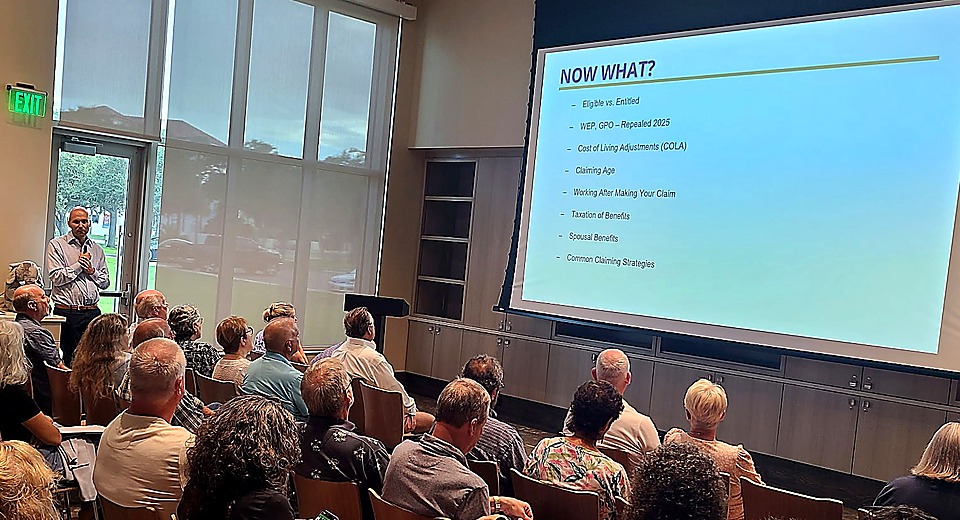
You are also welcome to start by simply learning. Our monthly educational workshops in New Smyrna Beach and Port Orange cover Social Security and taxes in retirement, the very topics an income-phase relationship should be addressing. See upcoming dates and register at nsbretirement.com/retirement-workshops-new-smyrna-beach-fl.
Or call New Smyrna Beach Retirement Solutions at 386-402-4626 to schedule a conversation. Bring your questions. That is what they are for.
Disclosure: Investment advisory products and services made available through Signal Advisors Wealth, LLC (Signal Wealth), an SEC Registered Investment Adviser. Insurance products are offered through the insurance business New Smyrna Beach Retirement Solutions. New Smyrna Beach Retirement Solutions is also an Investment Advisory practice that offers products and services through Signal Advisors Wealth, LLC (Signal Wealth), an SEC Registered Investment Adviser. Registration with the SEC does not imply a certain level of skill or training. Signal Wealth does not offer insurance products. The insurance products offered by New Smyrna Beach Retirement Solutions are not subject to investment adviser requirements. We are not affiliated with any government agency, and do not provide tax or legal advice. Investing involves risk, including possible loss of principal. No investment strategy can ensure a profit or guarantee against losses. Past performance may not be used to predict future results. Insurance product guarantees are backed by the financial strength and claims-paying ability of the issuing company. Investment advisory services are provided in accordance with a fiduciary duty of care and loyalty that includes putting your interests first and disclosing conflicts. Insurance services have a best interest standard which requires recommendations to be in your best interest. Advisors may receive commission for the sale of insurance and annuity products. Additional details including potential conflicts of interest are available in our firm's ADV Part 2A and Form CRS (for advisory services visit go.signaladvisors.com/signalwealth) and New Smyrna Beach Retirement Solutions Insurance Agent Disclosure for Annuities form (for annuity recommendations). Social Security information provided by New Smyrna Beach Retirement Solutions is educational and analytical in nature and does not constitute personalized Social Security advice. New Smyrna Beach Retirement Solutions and its agents are not employees of the Social Security Administration and cannot make official benefit determinations. Clients should confirm their filing decisions with the Social Security Administration at www.ssa.gov or their local SSA office.