
Estate planning problems rarely announce themselves. There is no warning light, no statement in the mail, no deadline on the calendar. An outdated beneficiary form can sit quietly in a file for twenty years, doing nothing, until the one day it matters, and on that day, it is too late to fix.
That is what makes this topic different from most retirement planning subjects. It is not urgent, ever, until it is final. And so it gets postponed, year after year, behind everything that feels more pressing. This article is about the quiet housekeeping most retirees are overdue for: the estate and beneficiary mistakes that families discover at the worst possible time, and the simple review habits that catch them early.
The mistake underneath most of the others
Here is the single most important sentence in this article: for many of your largest assets, your will does not decide who inherits them. Your beneficiary forms do.
Retirement accounts like IRAs and 401(k)s, life insurance policies, annuities, and accounts with payable-on-death designations generally pass directly to whoever is named on the beneficiary form, regardless of what your will says. A will that carefully divides everything among your children does not override a decades-old 401(k) form naming someone else.
Courts have upheld this principle in painful cases: benefits paid to ex-spouses named on forgotten forms, to deceased relatives’ estates, to one child when the intention was all three. The families in those stories were not careless people. They simply assumed the will was the last word, and it was not.
Common oversights, and the life events behind them
Beneficiary and estate problems rarely come from bad decisions. They come from good decisions that were never updated after life changed. The usual triggers:
Divorce and remarriage. Former spouses left on retirement accounts and insurance policies are among the most common and most contested oversights. Blended families add another layer: without deliberate planning, assets intended to eventually reach children from a first marriage may not get there.
Death of a spouse or named beneficiary. When a primary beneficiary dies, the contingent beneficiary, or the absence of one, suddenly matters. Many accounts have no contingent named at all, which can push the asset into probate, the very process beneficiary designations exist to avoid.
Births, and the passage of time. Grandchildren arrive, children become adults, and forms from the 1990s reflect none of it. Accounts have also multiplied along the way: rollovers, new institutions, old employer plans, each with its own form filled out on its own long-forgotten day.
A move to Florida. For transplants from up north, relocation is its own review trigger, covered below.
Retitled or restructured accounts. Consolidations, transfers, and new account openings sometimes reset or drop designations without the owner noticing. The form the institution has on file today is the only one that counts, and assuming it matches your memory is a gamble.
The Florida transplant’s extra homework
If you moved here from New Jersey, New York, or elsewhere up north, your estate documents made the trip in a box, but they were written for a different state’s laws. State rules differ on how documents are executed, how powers of attorney and healthcare directives work, and how probate proceeds. Florida also has distinctive homestead rules that can affect how your home passes and what your documents can do with it.
Old documents do not automatically fail here, but the only way to know how yours function under Florida law is to have them reviewed by a Florida-licensed estate attorney. For most transplant households, that review is a one-time task that resolves years of quiet uncertainty.
Titling: the third leg of the stool
Alongside wills and beneficiary forms sits a third factor people rarely think about: how accounts and property are titled. Joint ownership arrangements, payable-on-death designations, and trust ownership each carry their own inheritance consequences, and titling that contradicts your documents creates exactly the kind of conflict that surfaces after you are gone. Titling questions are attorney territory, but noticing the inconsistencies is something any organized household can do.
What is actually at stake
It would be easy to frame this topic purely in dollars, and money is part of it: assets landing in probate unnecessarily, taxes and costs that coordination might have reduced, inheritances routed to unintended recipients.
But ask any family who has lived through a beneficiary dispute and they will tell you the real cost was not financial. It was the sibling relationships strained over an ambiguous form, the surviving spouse fighting a paperwork battle while grieving, the sense that a parent’s true wishes were knowable but not documented. Estate housekeeping is ultimately an act of care for the people you love. Clean documents and current beneficiaries are a final gift of clarity.
A hypothetical discovery, too late and just in time
Consider the Hendersons, a hypothetical family. After the father’s passing, his children discover that his IRA, the largest asset he owned, still names his late first wife as primary beneficiary with no contingent listed, that his will was drafted in Pennsylvania before the move to Florida, and that one account was titled jointly with only one of his three children for “convenience.” Every one of those items was fixable in an afternoon while he was alive. After his passing, each becomes a legal process, and some become family arguments.
Now imagine the same family one timeline over, where a routine beneficiary review two years earlier caught all three items. Same assets, same intentions, entirely different ending. This example is hypothetical and for educational purposes only.
A simple review habit
You do not need to learn estate law. You need a recurring appointment with yourself:
- Once a year, or after any major life event, request current beneficiary confirmations from every retirement account, insurance policy, and annuity you own, and read them.
- Confirm every account has both primary and contingent beneficiaries that match your current intentions.
- If you have moved to Florida since your documents were drafted, have them reviewed by a Florida-licensed estate attorney.
- Keep a simple list of your accounts, policies, and document locations where your spouse or family can find it.
An hour or two a year can go a long way toward avoiding most of the problems in this article.
Let’s make sure the paperwork matches your intentions
Beneficiary and estate coordination is a standard part of how we think about retirement planning, because a plan that works during your lifetime should also work after it. We coordinate with qualified estate attorneys rather than practicing law ourselves, and we are glad to help you organize the review.
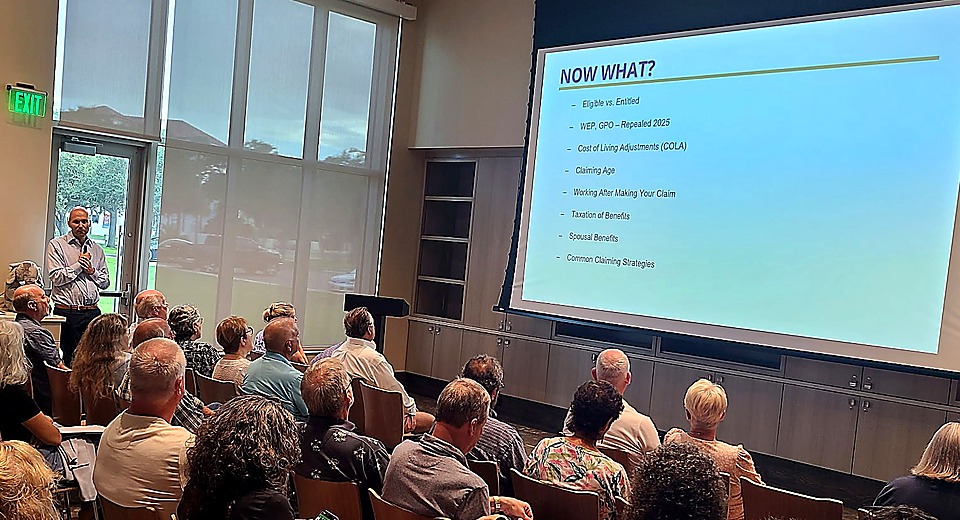
If it has been more than a few years since you looked at your beneficiary forms, or if your documents predate your move to Florida, consider this your nudge. Join us at one of our monthly educational workshops in New Smyrna Beach and Port Orange. Dates and registration are at nsbretirement.com/retirement-workshops-new-smyrna-beach-fl.
Or call New Smyrna Beach Retirement Solutions at 386-402-4626 to schedule a conversation.
Disclosure: Investment advisory products and services made available through Signal Advisors Wealth, LLC (Signal Wealth), an SEC Registered Investment Adviser. Insurance products are offered through the insurance business New Smyrna Beach Retirement Solutions. New Smyrna Beach Retirement Solutions is also an Investment Advisory practice that offers products and services through Signal Advisors Wealth, LLC (Signal Wealth), an SEC Registered Investment Adviser. Registration with the SEC does not imply a certain level of skill or training. Signal Wealth does not offer insurance products. The insurance products offered by New Smyrna Beach Retirement Solutions are not subject to investment adviser requirements. We are not affiliated with any government agency, and do not provide tax or legal advice. Investing involves risk, including possible loss of principal. No investment strategy can ensure a profit or guarantee against losses. Past performance may not be used to predict future results. Insurance product guarantees are backed by the financial strength and claims-paying ability of the issuing company. Investment advisory services are provided in accordance with a fiduciary duty of care and loyalty that includes putting your interests first and disclosing conflicts. Insurance services have a best interest standard which requires recommendations to be in your best interest. Advisors may receive commission for the sale of insurance and annuity products. Additional details including potential conflicts of interest are available in our firm's ADV Part 2A and Form CRS (for advisory services visit go.signaladvisors.com/signalwealth) and New Smyrna Beach Retirement Solutions Insurance Agent Disclosure for Annuities form (for annuity recommendations).