
Between the holiday cards and the family visits, December quietly serves another role in a retiree’s year: it is the deadline for a surprising number of financial decisions. Once the calendar turns, many of the year’s tax opportunities are simply gone, and any oversights are locked in.
Good retirement tax planning is a year-round discipline, not a December scramble. But the end of the year is a natural checkpoint, a moment to review the year’s income, distributions, gains, and giving while there is still time to act. Here is a practical checklist Florida retirees can walk through before the year ends.
First, a word to our fellow Floridians
“We moved to Florida, so we’re done with tax planning” is a sentence we hear more often than you might think, usually from recent transplants still enjoying the glow of leaving a state income tax behind.
The glow is deserved. Florida’s lack of state income tax is a real advantage. But it covers exactly one layer of the tax picture. Federal income tax still applies to your IRA withdrawals. Capital gains rules still apply to your investments. Required minimum distributions still arrive on schedule, and your income still influences what you pay for Medicare. Florida made your tax planning better. It did not make it unnecessary.
The year-end checklist
1. Confirm required minimum distributions are handled. Once you reach the age when required minimum distributions begin under current law, the IRS requires you to withdraw a minimum amount from most pre-tax retirement accounts each year, and the penalty rules for missing one are not gentle. Before December closes, confirm every account subject to the requirement has satisfied it, especially if you hold accounts at multiple institutions or have inherited retirement accounts, which follow their own rules. Do not assume a custodian handled it automatically. Verify.
2. Review realized gains and losses. If you sold investments in taxable accounts this year, you may have realized capital gains. Year-end is when many investors review whether any positions with losses could be sold to offset gains, a practice often called tax-loss harvesting. It is also when to be careful: rules exist around selling and quickly repurchasing similar investments, and investment decisions should never be driven by taxes alone. This is a review-with-your-advisor item, not a do-it-hastily item.
3. Think through charitable giving before December 31. If giving is part of your life, how you give can matter as much as how much. Retirees past the eligible age can give directly from an IRA to charity through what is known as a qualified charitable distribution, which can count toward required minimum distributions without adding to taxable income. Others may benefit from gifting appreciated investments rather than cash, or from grouping several years of giving into one. Each approach has rules and eligibility details, which is exactly why giving decisions made in early December beat giving decisions made on December 30.
4. Evaluate Roth conversion timing. For households considering Roth conversions, December is decision month, since a conversion counts toward the tax year in which it happens. By late in the year, you have a reasonably clear picture of your total income, which makes it possible to size a conversion to fit the room remaining in your intended tax bracket. We walk through when conversions help and when they backfire in a separate article on this blog; the year-end point is simply that the window closes with the calendar.
5. Look at your income as one number. Here is the step that ties the checklist together. Your IRA withdrawals, required distributions, capital gains, conversions, and other income do not exist in separate universes. They stack into a single year-end total, and that total drives your tax bracket, can influence how much of your Social Security is taxable, and feeds into the income calculation that sets Medicare premiums for higher-income retirees roughly two years later. Before making any final December moves, ask the simple question: what does this do to the whole-year number?
6. Sweep the small stuff. A few quick verifications round out the season: confirm any final estimated tax payment on your calendar, check that flexible spending or similar use-it-or-lose-it accounts are addressed if they apply to you, and note any account contributions you intend to make while their windows remain open.
A hypothetical December
Consider Ed and Barbara, a hypothetical retired couple in Edgewater, sitting down in early December for a year-end review. They confirm both of their required distributions have been taken. Reviewing their brokerage account, they notice realized gains from a summer sale and a position with a loss that their advisor discusses harvesting against it. They decide to make their church gift directly from Ed’s IRA rather than by check, having learned about qualified charitable distributions at a workshop. And after adding up the year’s income, they conclude that a Roth conversion this particular year would push them further up the brackets than they would like, so they pass, and note it for reconsideration next year.
Nothing about their December was dramatic. That is the point. This example is hypothetical and for educational purposes only, but the habit it illustrates, one unhurried review before the year closes, is available to everyone.
Bring in the professionals where it counts
A final and important note: this article is education, not tax advice. Several items on this checklist, particularly gains harvesting, charitable strategies, and conversions, have rules and thresholds that depend on your specific numbers. Year-end is the season when coordination between your retirement planner and a qualified tax professional pays for itself. If you have both, make sure they are talking. If you have neither, December is a fine month to change that.
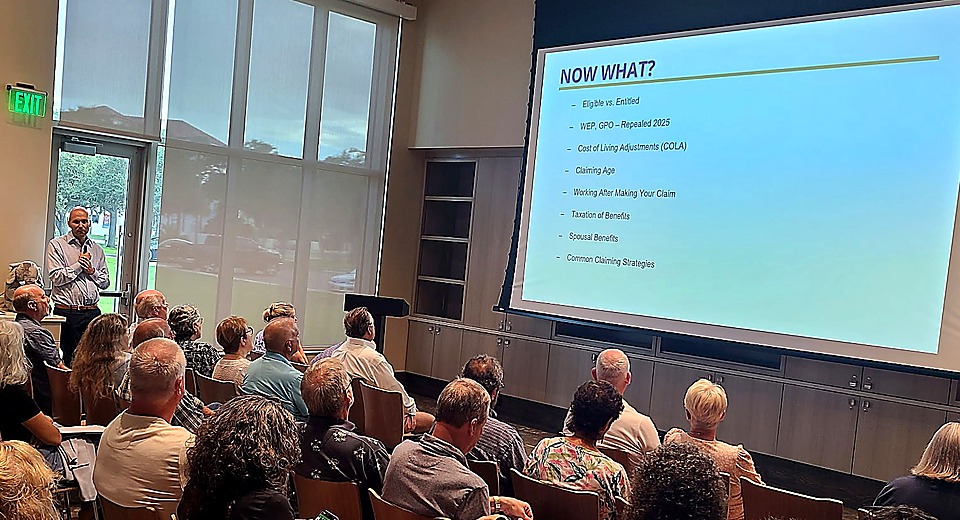
Taxes in retirement is one of the two core topics of our monthly educational workshops in New Smyrna Beach and Port Orange, and the year-end sessions are among our most practical. See upcoming dates and register at nsbretirement.com/retirement-workshops-new-smyrna-beach-fl.
Or call New Smyrna Beach Retirement Solutions at 386-402-4626 to schedule a year-end planning conversation before the calendar gets away from you.
Disclosure: This article is for general informational and educational purposes only. It does not constitute investment, tax, legal, or real estate advice. Investment advisory products and services made available through Signal Advisors Wealth, LLC (Signal Wealth), an SEC Registered Investment Adviser. Insurance products are offered through the insurance business New Smyrna Beach Retirement Solutions. New Smyrna Beach Retirement Solutions is also an Investment Advisory practice that offers products and services through Signal Advisors Wealth, LLC (Signal Wealth), an SEC Registered Investment Adviser. Registration with the SEC does not imply a certain level of skill or training. Signal Wealth does not offer insurance products. The insurance products offered by New Smyrna Beach Retirement Solutions are not subject to investment adviser requirements. We are not affiliated with any government agency, and do not provide tax or legal advice. Investing involves risk, including possible loss of principal. No investment strategy can ensure a profit or guarantee against losses. Past performance may not be used to predict future results. Insurance product guarantees are backed by the financial strength and claims-paying ability of the issuing company. Investment advisory services are provided in accordance with a fiduciary duty of care and loyalty that includes putting your interests first and disclosing conflicts. Insurance services have a best interest standard which requires recommendations to be in your best interest. Advisors may receive commission for the sale of insurance and annuity products. Additional details including potential conflicts of interest are available in our firm's ADV Part 2A and Form CRS (for advisory services visit go.signaladvisors.com/signalwealth) and New Smyrna Beach Retirement Solutions Insurance Agent Disclosure for Annuities form (for annuity recommendations).