
There is a conversation most families put off. It usually starts with a sentence like “we should probably talk about what happens if one of us needs care someday,” and it usually ends with “let’s talk about it another time.”
The avoidance is understandable. Nobody enjoys imagining a future where they or their spouse needs help with the basics of daily life. But there is a specific misunderstanding hiding inside that avoided conversation, and it is one of the most consequential assumptions in all of retirement planning: the belief that if care is ever needed, Medicare will handle it.
For most long-term care situations, it will not. This article explains why, calmly and without scare tactics, and what families can do about it.
Three kinds of care, in plain terms
To see the gap clearly, it helps to separate three things that often get lumped together:
Medical care is what we usually think of: doctors, hospitals, surgery, treatment for illness and injury. This is the territory Medicare was built for.
Rehabilitative care is recovery-focused: skilled nursing or therapy after a hospital stay, aimed at getting you back on your feet. Medicare provides meaningful but limited coverage here, generally tied to specific conditions and limited timeframes.
Custodial care, which is what most people mean by long-term care, is ongoing help with the activities of daily living: bathing, dressing, eating, moving around, managing the routines of the day. It may happen at home, in an assisted living community, or in a nursing facility, and it can continue for years.
The myth and the reality
The myth: “If I ever need long-term care, Medicare will cover it. That’s what it’s for.”
The reality: Medicare is designed around medical and short-term rehabilitative care, not ongoing custodial care. The coverage that exists for skilled nursing care after a hospital stay comes with conditions and time limits, and once care stops being about recovery and becomes about ongoing daily assistance, Medicare’s role largely ends. Extended custodial care, whether at home or in a facility, is generally not what Medicare pays for.
Medicaid, a different program, does pay for long-term care in certain settings, but it is designed for people with limited income and assets, and qualifying typically involves spending down resources first. For households that have spent a lifetime building savings, treating Medicaid as the default care plan means accepting exactly the outcome their saving was meant to prevent.
The result is a genuine gap: a category of expense that can be substantial and prolonged, sitting largely outside the programs retirees assume will handle it.
Why this matters most for couples
For a single retiree, a long-term care event is a financial planning challenge. For a married couple, it is something more delicate: the care needs of one spouse draw on the same savings that must also support the other spouse’s entire remaining life.
Picture the situation honestly. When one spouse needs extended care, the household is suddenly funding two lives in two very different circumstances at once. The caregiving spouse is often older themselves, managing the logistics and emotions of care while watching the joint resources flow toward it. And the question underneath it all is one nobody wants to ask out loud: what will be left for the healthy spouse’s remaining years?
This is why long-term care planning is not really about facilities or policies. It is about protecting the surviving spouse’s future, keeping choices open, and sparing adult children from making crisis decisions on their parents’ behalf.
How families begin thinking about funding care
There is no single right answer, but most households evaluate some combination of the following, in broad educational terms:
- Self-funding. Some families earmark a portion of their assets as the “if we ever need care” money and plan around it. This works better when it is an explicit part of a written retirement income plan rather than a vague hope that the money will stretch.
- Insurance-based approaches. A range of products exists that can help fund care, from traditional long-term care insurance to newer designs that combine care benefits with life insurance or other features. Each involves tradeoffs around cost, eligibility, and design, and whether any of them fits a given household is an individual question far beyond the scope of an article. Evaluating specific products is a conversation for a licensed professional, not a blog post.
- Family and home-based plans. Some families plan around care provided at home, sometimes with family involvement. This can be meaningful and cost-conscious, and it also carries real physical, emotional, and financial weight for the caregivers, which deserves honest discussion in advance.
- Legal and coordination steps. Regardless of funding approach, care planning connects to estate documents, powers of attorney, and healthcare directives, which makes coordination with a qualified elder law or estate attorney valuable for many families.
A hypothetical family, two timelines
Consider the Morgans, a hypothetical couple in their late sixties. In one timeline, they never have the conversation. Years later, when one of them needs extended care, every decision happens in crisis mode: the family learns about the Medicare gap in a hospital discharge meeting, the healthy spouse makes rushed financial decisions under stress, and the adult children argue about options nobody researched.
In the other timeline, the Morgans spend one unhurried season, while both are healthy, deciding how care would be funded, what their preferences would be, and getting documents in order. The care event, if it ever comes, is still hard. It is just no longer hard and unplanned. This example is hypothetical and for educational purposes only.
The difference between those timelines was not money. It was a conversation, had early.
Start the conversation before life starts it for you
The time to think about long-term care is when it feels least urgent, while you are healthy, your options are open, and decisions can be made thoughtfully rather than in a hospital hallway.
If your household has been putting this conversation off, consider letting this article be the nudge.
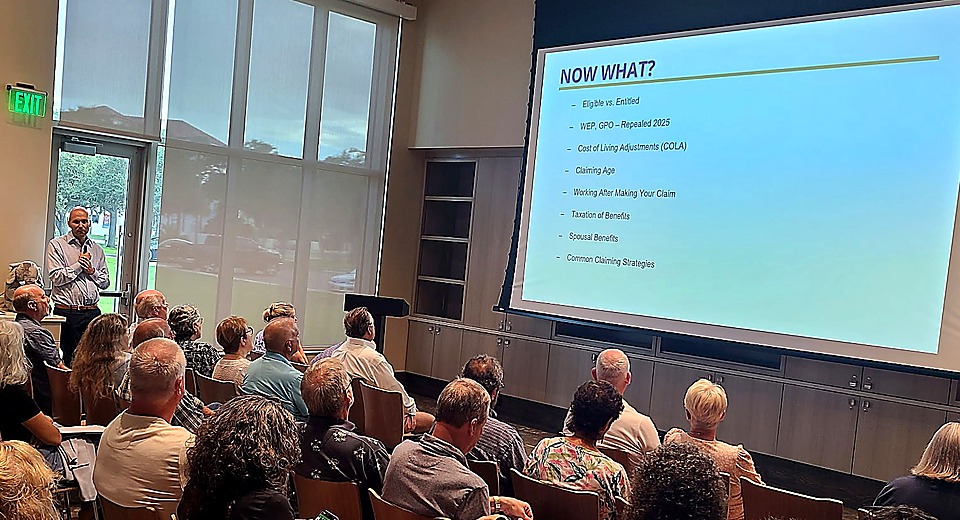
Care planning and its connection to retirement income is among the topics we discuss at our monthly educational workshops in New Smyrna Beach and Port Orange. See upcoming dates and register at nsbretirement.com/retirement-workshops-new-smyrna-beach-fl.
Or, if you would prefer to talk privately about how this fits your family's plan, call New Smyrna Beach Retirement Solutions at 386-402-4626.
Disclosure: New Smyrna Beach Retirement Solutions and its agents are not affiliated with or endorsed by the U.S. Government, the federal Medicare program or any governmental agency. References to Medicare are for general informational purposes only. New Smyrna Beach Retirement Solutions and its agents do not offer Medicare Advantage, Medicare Supplement, or Part D plan enrollment services unless specifically licensed and appointed to do so. For Medicare-specific guidance, visit medicare.gov or contact 1-800-MEDICARE (1-800-633-4227). NSBRS may receive referral fees or other compensation in connection with referrals made to licensed Medicare insurance specialists; this arrangement represents a conflict of interest and is disclosed here. Clients are under no obligation to use any referred specialist and may seek Medicare enrollment assistance from any licensed agent of their choice. Investment advisory products and services made available through Signal Advisors Wealth, LLC (Signal Wealth), an SEC Registered Investment Adviser. Insurance products are offered through the insurance business New Smyrna Beach Retirement Solutions. New Smyrna Beach Retirement Solutions is also an Investment Advisory practice that offers products and services through Signal Advisors Wealth, LLC (Signal Wealth), an SEC Registered Investment Adviser. Registration with the SEC does not imply a certain level of skill or training. Signal Wealth does not offer insurance products. NSBRS is not affiliated with Signal Wealth. The insurance products offered by New Smyrna Beach Retirement Solutions are not subject to investment adviser requirements. We are not affiliated with any government agency, and do not provide tax or legal advice. Investing involves risk, including possible loss of principal. No investment strategy can ensure a profit or guarantee against losses. Past performance may not be used to predict future results. Insurance product guarantees are backed by the financial strength and claims-paying ability of the issuing company. Investment advisory services are provided in accordance with a fiduciary duty of care and loyalty that includes putting your interests first and disclosing conflicts. Insurance services have a best interest standard which requires recommendations to be in your best interest. Advisors may receive commission for the sale of insurance and annuity products. Additional details including potential conflicts of interest are available in our firm's ADV Part 2A and Form CRS (for advisory services visit go.signaladvisors.com/signalwealth) and New Smyrna Beach Retirement Solutions Insurance Agent Disclosure for Annuities form (for annuity recommendations).